
Explore Diving with Giant Cuttlefish: South Australia & Worldwide
Peter Letts Jun 16, 2023
Australia's largest cuttlefish
Diving with Giant Australian Cuttlefish: Whyalla and Sydney Guide
How to recognise Ascarosepion apama, understand its extraordinary displays and plan a responsible encounter using the latest 2026 access advice.
Giant Australian cuttlefish are not fish. They are short-lived cephalopod molluscs—the same wider group as squid and octopuses—and the world's largest cuttlefish species. Adults can approach one metre in total length. Sydney divers may meet individual animals on temperate rocky reefs, while the Upper Spencer Gulf supports the only known annual mass breeding aggregation of this species.
What is a giant Australian cuttlefish?
The accepted scientific name used by the Australian Museum and the Australian Faunal Directory is Ascarosepion apama. Many dive guides and scientific papers use the earlier combination Sepia apama; both names refer to the same species. It is endemic to Australia, with records from Queensland, New South Wales, Victoria, Tasmania, South Australia and Western Australia.
A cuttlefish has eight arms, two longer retractile feeding tentacles and an internal, gas-filled cuttlebone that assists with buoyancy. That chalky cuttlebone is the familiar object found on beaches. Broad fins running along the mantle help the animal hover and move with remarkable precision; rapid jet propulsion is available when it needs to escape.
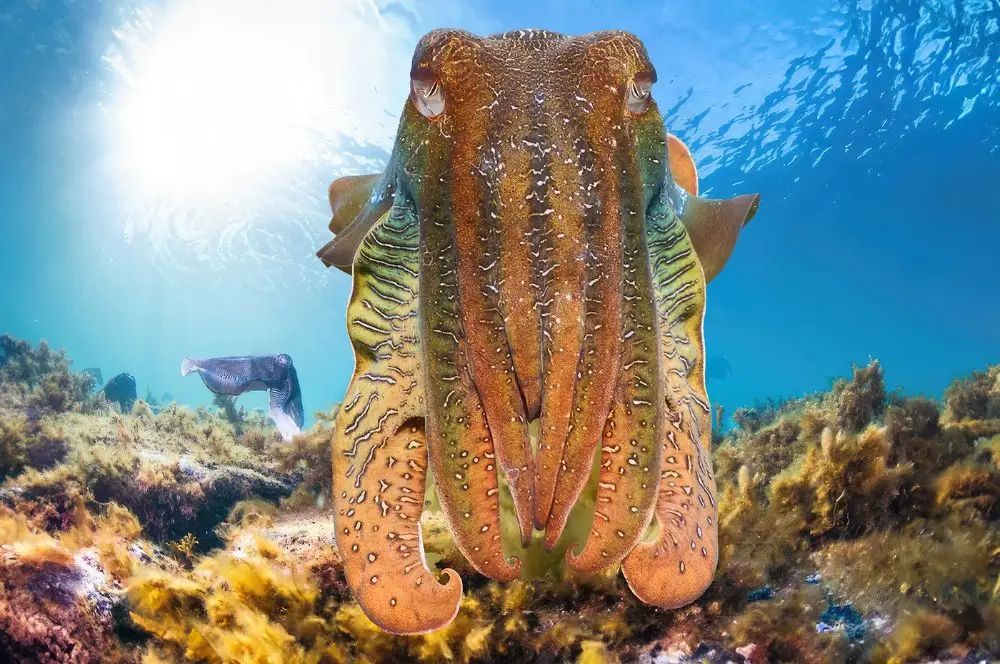
How can cuttlefish change colour and texture so quickly?
Colour and pattern
Expandable pigment organs called chromatophores let the animal produce spots, bands and moving waves of contrast. Deeper reflective cells contribute iridescent and pale effects.
Three-dimensional texture
Muscular structures in the skin can raise papillae, breaking up the outline so the animal resembles rock, weed or rough seabed rather than a smooth-bodied cephalopod.
Visual signalling
Body pattern, arm position and posture can be used for camouflage, courtship, rivalry and prey capture. Context matters; colour alone is not a reliable emotional label.
The transformation can appear theatrical to a diver, but it is highly practical biology. A cuttlefish may match a patch of reef, flash a high-contrast warning toward a rival and show a different pattern on the other side of its body. That ability to control its visual appearance is one reason a quiet, stationary encounter is often far more rewarding than following the animal.
Courtship at the Spencer Gulf aggregation
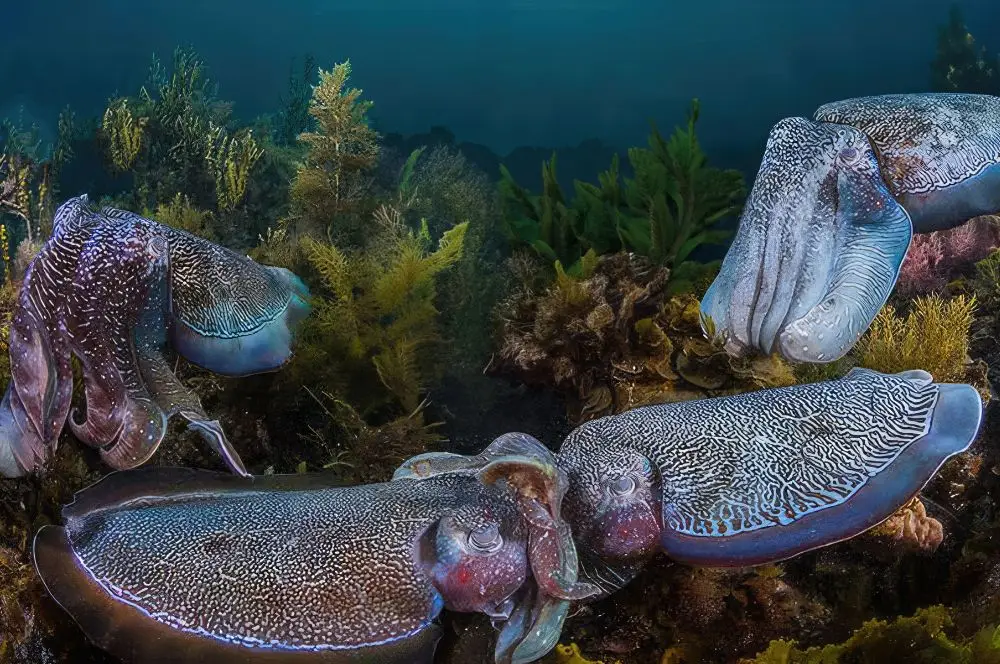
From about May to August, mature animals normally converge on rocky reef near Point Lowly in the Upper Spencer Gulf. Females place eggs beneath suitable rocks and in protected crevices. Males display, compete and attempt to guard access to females in a densely social mating system unlike the mostly solitary life seen at other times.
Size is not the only route to mating success. Research at the aggregation documented smaller males adopting female-like colouring and posture to pass a guarding male, then switching back to male display when an opportunity arose. This flexible female mimicry is one of the best-known examples of alternative mating behaviour in a cephalopod.
Why the 2026 Spencer Gulf season is different
Numbers at the aggregation naturally rise and fall, and strong recoveries have occurred before. Even so, the 2026 estimate is unprecedented. Government monitoring estimated 1,811 animals in the Point Lowly aggregation—not the species' total Australian population—compared with about 64,000 there in 2025 and a previous monitored low of 13,500 in 2013. The highest aggregation estimate was 247,000 in 2020.
The South Australian Government has expanded research into population variability and extinction risk. Possible drivers under investigation include environmental conditions, food availability, temperature and effects associated with the harmful algal bloom. It is too early to present any one factor as the confirmed cause. Encouragingly, the 2026 surveys still recorded adults spawning and eggs being laid, which means the breeding cycle continues.
Protection has two distinct parts. First, taking any cuttlefish is permanently prohibited north of the Arno Bay–Wallaroo line, while taking any cephalopod is prohibited in the False Bay exclusion zone; the maximum fine stated by the South Australian Government is $20,000. Second, the temporary 2026 exclusion limits recreational access in part of the breeding site. Following both the fishing rules and the current marine-park alert is essential.
Seeing giant cuttlefish in Sydney versus Spencer Gulf
Sydney lies within the species' natural range, and local divers may encounter giant cuttlefish among rocky reef, kelp, sand edges and sheltered ledges. Cooler months can bring more sightings and reproductive activity, but wildlife is never guaranteed. Sydney does not have the vast mass aggregation associated with Point Lowly.
| What to compare | Sydney reefs | Upper Spencer Gulf |
|---|---|---|
| Type of encounter | Usually an individual animal or a small number encountered during a wider temperate-reef dive. | The world's only known annual mass breeding aggregation of the species. |
| Timing | Possible year-round; local sightings often increase in the cooler part of the year. | Breeding animals normally gather from May to August; eggs hatch later in spring. |
| Planning | Choose a site and conditions that match your certification, recent experience and comfort. | Check the live park alert before travel. The Black Point–Stony Point in-water exclusion is active at the time of this update. |
| Expectation | A rewarding possibility within a diverse Sydney marine-life dive, never a guaranteed sighting. | Historically a major seasonal spectacle, but conservation needs take priority in 2026. |
If your goal is a local encounter, a guided Sydney marine-life dive gives you the best chance to learn where cuttlefish shelter and how to approach without disturbing them. Use the Sydney dive calendar to choose a dive suited to your current experience rather than selecting a site solely for a hoped-for animal sighting.
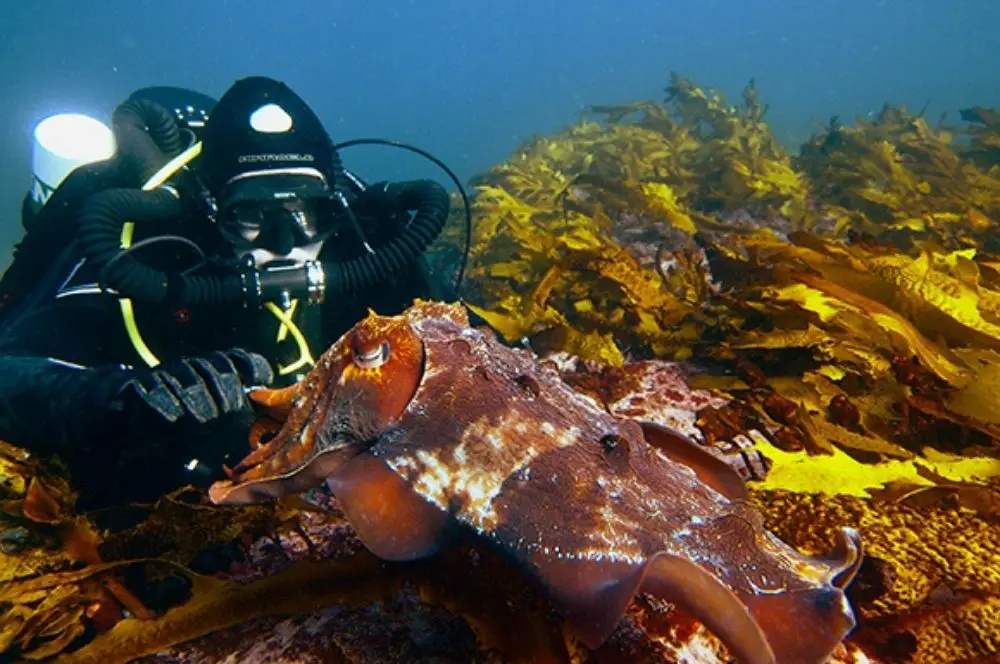
How to behave around a giant cuttlefish
Planning for a future Spencer Gulf season: if official access reopens, treat the site as cold-water, condition-dependent diving or snorkelling—not a universally easy swim. Park guidance notes water around 10–16°C, substantial tidal movement in parts of the gulf, changing currents and rocky entries. Use suitable exposure protection, stay within your training and experience, dive with a buddy and follow current local advice.
Stop and settle
Establish calm, neutral buoyancy at a respectful distance. A stationary diver is less intrusive and less likely to stir sediment over the animal or nearby eggs.
Leave an open escape route
Do not surround, corner or block a cuttlefish against rock. If it moves away, let it choose the distance rather than pursuing it.
Never touch or manipulate
Do not touch the animal, shift rocks, expose eggs or provoke a colour change for a photograph. Observe behaviour that occurs naturally.
Control the photography
Approach slowly, limit repeated close passes and keep fins, gauges and camera equipment clear of the reef. A clean composition is not worth habitat damage.
Follow the current local rule
Site briefings, closures and protected-area rules override general advice. In the affected Upper Spencer Gulf zone, staying out of the water is presently the responsible encounter.
Do not confuse it with the broadclub cuttlefish
Giant Australian cuttlefish
Ascarosepion apama is endemic to Australia and belongs to temperate southern waters. It is the species seen around Sydney and at the Upper Spencer Gulf aggregation.
Broadclub cuttlefish
Ascarosepion latimanus (formerly Sepia latimanus) is an Indo-Pacific tropical species commonly encountered in places such as Indonesia. It is impressive, but it is not the giant Australian cuttlefish and should not be presented as the same animal.
Frequently asked questions
What is the current scientific name of the giant Australian cuttlefish?
The accepted name is Ascarosepion apama. The older name Sepia apama remains common in dive guides and scientific literature and refers to the same species.
How big does a giant Australian cuttlefish grow?
It can reach about one metre in total length and weigh up to approximately 10.5 kilograms, making it the world's largest cuttlefish species.
Where can divers see giant Australian cuttlefish?
The species is endemic to Australia, with records from Queensland, New South Wales, Victoria, Tasmania, South Australia and Western Australia. Sydney divers may encounter individuals on temperate reefs. The Upper Spencer Gulf is famous for the species' annual mass breeding aggregation.
When is the Spencer Gulf cuttlefish aggregation?
The usual breeding period is May to August, with eggs generally hatching from September into late October. Animal numbers and access conditions vary, so seasonal timing alone is not permission to enter a site.
Can I dive or snorkel at Stony Point in 2026?
Not within the affected exclusion zone while the temporary restriction remains active. It began on 1 July 2026 for 90 days and covers in-water recreation and vessel anchoring between Black Point and Stony Point. Check the Parks SA closure alert immediately before travel because the official status can change.
Are giant Australian cuttlefish protected?
Taking cuttlefish and other cephalopods is prohibited in designated northern Spencer Gulf areas, and giant Australian cuttlefish have permanent statutory protection there. Separate temporary access restrictions may also apply at the breeding site. Rules elsewhere are different, so always check the relevant state and marine-park regulations.
Are cuttlefish fish?
No. Cuttlefish are molluscs in the class Cephalopoda, alongside squid, octopuses and nautiluses. Their internal cuttlebone is a buoyancy structure rather than the bony skeleton of a fish.
Are broadclub cuttlefish in Bali the same species?
No. The tropical broadclub cuttlefish is Ascarosepion latimanus (formerly Sepia latimanus). The giant Australian cuttlefish is Ascarosepion apama, an Australian temperate-water species.
Sources and current-status checks
- Australian Museum: Giant Cuttlefish — taxonomy, size, distribution and life history.
- Australian Government: Cuttlefish Coast Sanctuary Zone — size, weight, breeding habitat and National Heritage context.
- South Australian Department for Environment and Water, 21 August 2026 — latest population estimate and research response.
- SARDI: 2026 Giant Australian Cuttlefish population estimate — survey method, aggregation estimate and context.
- Parks SA: Upper Spencer Gulf Marine Park closure alert — live access status.
- PIRSA: current cuttlefish rules — northern Spencer Gulf protection and cephalopod exclusion zones.
- Norman, Finn and Tregenza (1999) — peer-reviewed study of female mimicry as an alternative reproductive strategy.
- Atlas of Living Australia species record — accepted name and synonym.
Explore Sydney's temperate marine life
Giant cuttlefish are one part of Sydney's remarkable underwater story. Choose a guided dive for your experience level, enjoy the whole reef and let every wildlife encounter happen on the animal's terms.

 Trusted by Sydney divers