
Understanding the Moray Eel: Myths and Facts Unveiled
Peter Letts Mar 02, 2025

Sydney marine life guide
Moray Eels in Sydney: Species, Behaviour and Facts
Meet Sydney's green moray, discover why morays gape and learn how their remarkable second jaws work.
Few reef animals look as dramatic as a moray eel. A head emerges from a dark crack, curved teeth remain exposed and the mouth repeatedly opens and closes. It can look threatening, but the appearance is misleading. Morays are specialised fish, and that familiar gaping motion is normally how they move water across their gills to breathe.
The short answer: moray eels do not normally hunt or chase people. They should still be treated as wild predators with powerful jaws. Observe without touching, feeding, cornering or putting a hand into their shelter. A relaxed diver who gives the eel space can enjoy one of Sydney's most memorable marine-life encounters.
What is a moray eel?
A moray is an elongated bony fish belonging to the eel order Anguilliformes and the family Muraenidae. Its body plan is ideal for moving through cracks, caves and reef rubble. Most morays lack pectoral and pelvic fins, and their dorsal, tail and anal fins form a continuous fin around the rear of the body. Their skin has no conventional fish scales and is protected by a coating of mucus.
The family contains more than 200 recognised species. Although tropical coral reefs hold the greatest variety, morays are not exclusively tropical. Temperate species live along southern Australia and New Zealand, including the eels encountered by divers on Sydney's rocky reefs.
Why do morays live in holes?
A crevice is shelter and a hunting position. During the day, a diver may see only an eel's head protruding beneath a ledge. From there it can monitor its surroundings while most of its body remains protected. Many species become more active after dark, leaving cover to search for fish, crustaceans or cephalopods. “Mostly nocturnal” is more accurate than saying every moray only hunts at night; activity differs by species, habitat and opportunity.
Moray eels around Sydney
Sydney is not a coral-reef destination, yet its temperate rocky reefs provide exactly the shelter morays need. The Australian Museum notes several moray species around Sydney, with additional tropical species occasionally arriving as juveniles in the East Australian Current.
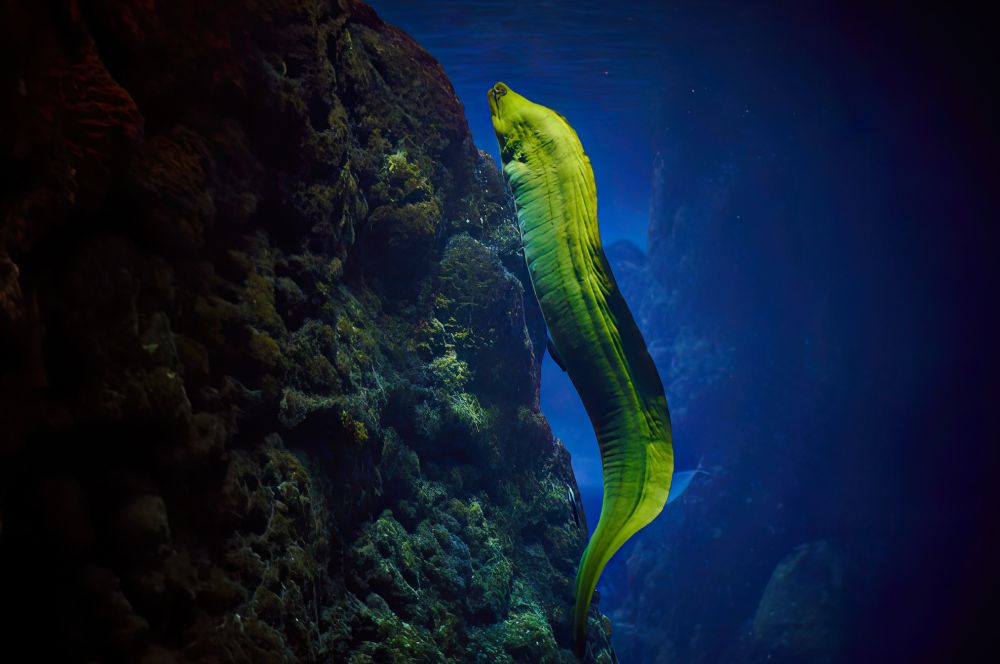
Green moray or Sydney green eel
Gymnothorax prasinus
This is the familiar local moray for many Sydney divers. Despite the name, individuals may appear yellow, olive, greenish or brown. They use shallow rocky and weed-covered reefs, sheltered bays and estuaries, and can also occur deeper. The Australian Museum reports a maximum length of about 1.5 metres.
Speckled moray
Gymnothorax obesus
Another temperate species found along the NSW coast, the speckled moray can be distinguished from the more uniform green moray by its mottled or speckled pattern. As with any underwater identification, colour alone can mislead because depth, torch light and the eel's mucus coating change what the diver sees.
Look beneath ledges and into crevices on suitable rocky reefs, but keep hands, gauges and camera equipment outside the shelter. Sites such as Bare Island have complex reef habitat and abundant marine life; no particular animal sighting is ever guaranteed. A slow pace, good buoyancy and an observant buddy usually reveal more than searching aggressively.
Local naming can be confusing. Sydney's Gymnothorax prasinus is often called the green moray, yellow moray or Sydney green eel. It is not the same species as the much larger Atlantic green moray, Gymnothorax funebris, which is frequently described in overseas articles.
Built for life inside the reef
Why a moray keeps opening its mouth
The classic moray “snarl” is usually respiration, not aggression. Morays have small, round gill openings behind the head rather than the large bony gill covers seen on many fish. Repeatedly opening and closing the mouth moves oxygenated water across the gills and out through those openings. The teeth remain visible because many species have a naturally wide gape.
The second jaws hidden in the throat
Morays possess pharyngeal jaws in the throat, as do many fishes, but their version is unusually mobile. Research published in Nature showed that these jaws can move forward into the mouth, grasp prey and transport it backwards. This helps a moray swallow relatively large prey even though its narrow head produces less suction than the expanding mouth of many other predatory fish.

Smell, vision and tubular nostrils
Morays have relatively small eyes and rely heavily on chemical cues. Their conspicuous nostrils sample the water for scent, helping them locate prey in dim crevices or at night. It is safer to say that smell is especially important than to claim that every moray is almost blind. Vision and sensory adaptations vary across a diverse family occupying habitats from shallow reef to deep water.
Skin, mucus and the “toxic eel” story
The mucus layer reduces abrasion as a moray moves through rough rock and helps protect its scaleless skin. Chemical compounds with toxic activity have been identified in the mucus or blood of some species, and some large tropical morays can also accumulate ciguatoxins when eaten. That does not make a moray's bite a venomous injection like a sea snake's bite. For a diver, the immediate hazards are the mechanical injury, bleeding, retained tooth fragments and contamination of a marine wound.
What moray eels eat and how they hunt
Morays are carnivorous predators and scavengers. Diet varies with species and tooth shape. Morays with long, recurved teeth are well equipped to grip slippery fish and cephalopods, while species with blunt crushing teeth specialise more heavily on crabs, prawns, molluscs and other hard-shelled prey.
Many hunt by ambush. An eel waits inside cover, lunges when suitable prey comes within reach and then uses its oral and pharyngeal jaws to control and swallow the catch. Morays can also leave the shelter and search through reef cracks, particularly after dark. Some use body knots as leverage when tearing pieces from prey or extracting food.
Do morays really hunt with groupers?
Cooperative hunting between groupers and giant morays has been scientifically documented in the Red Sea. A grouper can pursue prey in open water while a moray searches narrow reef spaces, making escape harder. It is an extraordinary example of communication between different fish species—but it should not be presented as universal behaviour shared by every moray in every ocean.
Moray eel myths and facts
| Claim | What the evidence says |
|---|---|
| MythAn open mouth means the eel is about to attack. | The regular opening and closing motion normally pumps water over the gills. Watch the whole animal and respect its space, but do not mistake breathing for a threat display. |
| MythMorays are sea snakes. | They are ray-finned fish and true eels. Their long body and lack of pectoral fins create the snake-like appearance. |
| FactMorays have a second set of jaws. | Their highly mobile pharyngeal jaws move forward to grasp prey and help transport it into the oesophagus. |
| MythEvery moray is an apex predator. | Morays are important predators, but their ecological position varies greatly with species, body size and habitat. Smaller morays can themselves be prey. |
| MythA moray bite injects venom. | Morays do not have venom-delivering fangs. The bite is still medically important because the teeth and jaws can cause deep trauma and any marine bite can become infected. |
| FactFeeding makes encounters less predictable. | Food, fish scraps or spearfishing catch can draw a moray close and create mistaken-identity bites. Never hand-feed wild morays. |
How to observe morays responsibly
An undisturbed moray is not normally interested in a diver as prey, but it remains a wild predator capable of a serious bite. Published case reports associate many injuries with hands entering occupied holes or with food and freshly cut fish attracting eels. The best approach is calm, hands-off observation.
Do
- Maintain neutral buoyancy and keep your hands to yourself.
- Approach slowly and leave the eel a clear retreat.
- Keep fingers, torches and cameras outside its crevice.
- Back away calmly if an eel leaves cover and approaches.
- Let the animal decide how long the encounter lasts.
Avoid
- Touching, grabbing or attempting to move the eel.
- Hand-feeding or carrying exposed bait near a moray.
- Putting a hand into any hole you cannot fully inspect.
- Blocking the entrance to its shelter for a photograph.
- Interpreting a respiratory gape as an invitation to move closer.

For bite prevention, first aid and guidance on when to seek urgent care, read Are Moray Eels Dangerous to Scuba Divers?
Respecting morays and their reef habitat
There is no single conservation status that applies to every moray eel. The family contains hundreds of species with different ranges, population knowledge and pressures. That is why statements such as “moray eels are not threatened” are too broad. Status must be checked species by species.
FishBase currently lists Sydney's green moray, Gymnothorax prasinus, as Least Concern. That global category does not mean every local population trend is well measured, and it should not be applied to unrelated moray species.
Divers can help without touching an eel at all: protect rocky reef and estuary habitats, maintain buoyancy, avoid breaking or shifting cover, never feed wildlife and take only photographs. If recording a sighting, include the site, date, approximate depth, habitat and a clear photograph taken without disturbing the animal.

Frequently asked questions
Will a moray eel chase a diver?
That is not normal predatory behaviour. An eel may leave its shelter, investigate, flee or react defensively if crowded. Food-conditioned animals may also approach people. Stay calm, keep hands away and create space.
Why do moray eels always look angry?
Their curved teeth, fixed facial shape and repeated respiratory gape create an intimidating expression. Opening and closing the mouth is normally how a moray pumps water over its gills, not a sign that it is angry.
Are moray eels venomous or poisonous?
Morays do not inject venom through specialised fangs. Some species have biologically active compounds in mucus or blood, and some tropical morays can cause ciguatera poisoning if eaten. Neither fact makes ordinary observation hazardous. A bite remains serious because it can cause deep trauma and infection.
Are moray eels dangerous to scuba divers?
They do not normally hunt or chase divers, but they can inflict a serious bite if fed, handled, cornered or disturbed inside a shelter. Give the eel space and keep hands out of crevices. See our complete moray safety and bite guide.
What moray eel is common in Sydney?
The green moray, Gymnothorax prasinus, is the best-known local species and is also called the yellow moray or Sydney green eel. Speckled morays also occur along the NSW coast.
Where should I look for a moray while diving?
Scan beneath rocky ledges, around caves and along crevices. By day you may see only the head; at night an eel may be moving across the reef. Never insert a hand, torch or camera into a hole to force a closer view.
Sources and further reading
- Australian Museum: Green Moray, Gymnothorax prasinus
- Fishes of Australia: Green Moray
- Reef Life Survey: Gymnothorax prasinus
- FishBase: Family Muraenidae
- FishBase: Green Moray status and ecology
- Mehta & Wainwright: raptorial pharyngeal jaws in moray eels
- Bshary et al.: cooperative hunting by groupers and giant morays
- Riordan et al.: moray eel bite case report and review
- Healthdirect Australia: sea-creature bites and stings
Discover Sydney's marine life in the wild
Join an upcoming Abyss dive and explore the rocky reefs, ledges and sponge gardens where Sydney's remarkable marine animals live.

 Trusted by Sydney divers