
Unmasking The Mystery: Sydney's Very Own Port Jackson Sharks
Peter Letts Jun 18, 2023

Sydney marine life guide
Port Jackson Sharks in Sydney: Season, Behaviour and Diving
Meet the distinctive bullhead shark with harness markings, crushing teeth and one of the ocean's most recognisable spiral egg cases.
Port Jackson sharks are endemic to southern Australian waters—not just Sydney Harbour. Sydney divers most often encounter these bottom-dwelling sharks on shallow rocky reefs during the cooler breeding season, when they rest in caves, ledges and gutters.
The species takes its common name from Port Jackson, the colonial name James Cook applied to Sydney Harbour in 1770; the harbour and its foreshores are Country for the Gadigal, Cammeraygal, Wangal and other Eora peoples. Its scientific name is Heterodontus portusjacksoni, and it belongs to the bullhead shark family. For a shorter overview, see our Port Jackson shark fact sheet.
Port Jackson shark facts at a glance
- Scientific name
- Heterodontus portusjacksoni
- Maximum length
- About 1.65 metres
- Range
- Temperate southern Australia
- Habitat
- Rocky reef, sand and seagrass to 275 metres
- Diet
- Sea urchins, molluscs, crustaceans and fish
- Sydney season
- Usually late winter through spring
- Safety
- Generally harmless; never handle or harass
- Status
- Least Concern; Australian assessment Sustainable
When are Port Jackson sharks seen in Sydney?
Late winter through spring is usually the best time for Sydney divers to see Port Jackson sharks gathering on inshore reefs to mate and lay eggs. Timing and numbers vary with location, conditions and the individual animals, so sightings are never guaranteed.
During the day, they commonly rest beneath ledges or in rocky gutters. They become more active after dark, moving across reef, sand and seagrass in search of food. Eastern Australian animals have also been recorded travelling hundreds of kilometres between NSW reproductive sites and feeding areas around Bass Strait, then returning to familiar locations.
If you are planning a shore dive, read our guide to diving in Sydney and check today's Sydney diving conditions. Site access and suitability can change, and every dive should match your training and experience.
How to identify a Port Jackson shark
Look for a broad, blunt head, raised ridges above the eyes and dark harness-shaped bands over a pale grey-brown body. A strong spine sits at the front of each of the two dorsal fins.
Port Jackson sharks can reach about 1.65 metres, although many are smaller. Australian Museum measurements place males commonly around 75 centimetres and females around 80–95 centimetres.

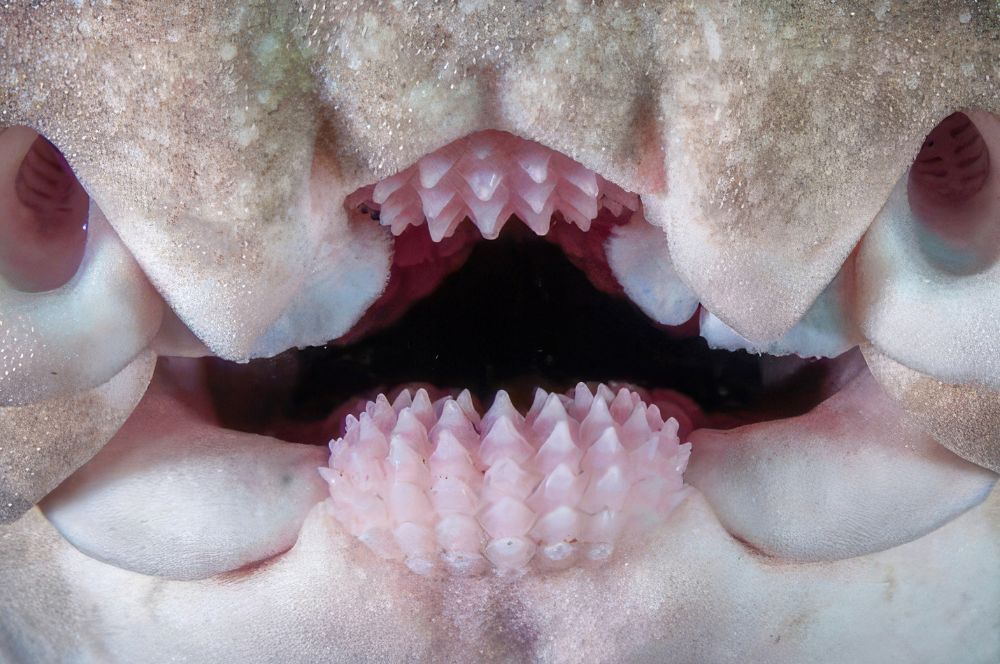
Different teeth for a hard-shelled diet
The genus name Heterodontus means “different tooth”. Small pointed teeth at the front seize prey, while broad, flattened teeth farther back crush sea urchins, molluscs and crustaceans. Port Jackson sharks also eat some fish.
They usually forage at night. Juveniles can suction-feed by drawing sand and water into the mouth, expelling the sand through the gills and retaining small prey. Port Jackson sharks can actively pump water across their gills while resting, so they do not need continuous forward movement to breathe.

Spiral eggs, breeding and long-distance migration
Port Jackson sharks are egg-layers. During the breeding season, a female produces tough, corkscrew-shaped egg cases and wedges them into protected reef crevices.
The spiral flanges help anchor an egg case between rocks. The embryo develops for about 10–12 months before a fully formed pup, roughly 23–25 centimetres long, emerges. There is no parental care after the egg is laid.


Tracking and genetic research show that these sharks are not simply permanent residents of one reef. Some eastern individuals migrate between Bass Strait feeding grounds and NSW breeding areas, while repeatedly returning to familiar reproductive sites. Researchers describe this return behaviour as site fidelity or reproductive philopatry.
They can learn and remember
Controlled experiments with juvenile Port Jackson sharks found that they could learn to associate sensory cues with a reward and retain learned associations beyond the initial training. This is better evidence of learning and memory than vague claims that the species is simply “surprisingly intelligent”.

Are Port Jackson sharks dangerous to divers?
Port Jackson sharks are generally considered harmless to people. They are usually calm around respectful divers, but they are wild animals and can bite if handled or harassed. Their dorsal-fin spines are also sharp.
A good encounter gives the shark control over the distance. Slow down, keep your buoyancy tidy and let the animal rest or move away without pressure.
- Never touch, hold, feed, chase or ride a shark.
- Do not block the entrance to a cave, ledge or gutter.
- Keep fins and equipment off the reef and away from resting animals.
- Never move, open or collect a spiral egg case—even if it appears empty.
- Avoid surrounding an animal for photographs; leave a clear escape route.
Conservation status and ongoing pressures
The Port Jackson shark is assessed as Least Concern globally and in Australia. Australia's 2023 national shark assessment also classifies the stock as Sustainable.
The species is taken as bycatch in several fisheries, but most recorded individuals are released alive and research indicates comparatively high post-release survival. A secure status is not permission to disturb animals or their habitat: protecting reef structure, respecting seasonal aggregations and leaving egg cases in place all matter.
Watch Port Jackson sharks on Sydney reefs
See their body shape, markings and calm resting behaviour in this short Abyss Scuba Diving video.
Port Jackson shark FAQs
When is Port Jackson shark season in Sydney?
They are most commonly seen gathering on Sydney's inshore reefs from late winter through spring. The exact arrival, departure and number of sharks vary, and no wildlife sighting can be guaranteed.
Are Port Jackson sharks dangerous to divers?
They are generally considered harmless and normally ignore calm divers. Like any wild animal, however, a Port Jackson shark may defend itself if grabbed or harassed, and its dorsal spines are sharp. Look, do not touch.
How large do Port Jackson sharks grow?
The recorded maximum is about 1.65 metres. Most are smaller; males are commonly around 75 centimetres and females around 80–95 centimetres.
Why is a Port Jackson shark egg case spiral-shaped?
The corkscrew-like flanges help a female lodge the egg case securely in a rocky crevice, where the embryo develops for roughly 10–12 months.
Where do Port Jackson sharks go in summer?
Movements vary, but tagged eastern Australian sharks have travelled hundreds of kilometres between NSW reproductive sites and feeding grounds around Bass Strait. Some also move into deeper water after breeding.
Can a Sydney dive guarantee a Port Jackson shark sighting?
No. Port Jackson sharks are wild and seasonal. A well-chosen reef dive in the cooler months may improve the chance of an encounter, but conditions, access and animal movements determine what divers see.
Explore Sydney's seasonal shark life
Port Jackson sharks are wild, so sightings can never be guaranteed. During Sydney's cooler months, a guided reef dive can offer the chance to encounter them alongside the city's other remarkable marine life.
Sources and further reading
Biology and status checked 25 August 2026 against the following museum, government and peer-reviewed sources:
- Australian Museum: Port Jackson Shark
- Fishes of Australia: Heterodontus portusjacksoni
- Australian Shark Report Card 2023: Port Jackson Shark
- Animal Cognition: learning and memory in juvenile Port Jackson sharks
- Macquarie University: reproductive philopatry research
- Dictionary of Sydney: Port Jackson

 Trusted by Sydney divers