

Integrated breathing
Explore a system that combines face protection, vision and gas delivery, with breathing characteristics that differ from a standard half mask and second stage.
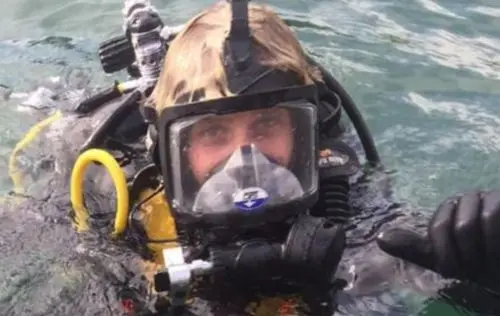
Discover the freedom and versatility of diving with a full face mask (FFM). This specialty allows you to breathe naturally through your nose and mouth, enjoy improved communication, and stay warmer in cooler water. Whether you’re preparing for more advanced diving, working towards professional dive skills, or just want to experience a new way of exploring the underwater world, this private course is the perfect option.
Availability: Contact us for booking information
Private PADI specialty • Sydney
Learn to fit, check, clear and dive with a full face mask during focused private training. Develop the different emergency procedures this equipment requires before applying the skills in confined water and on two instructor-guided ocean dives.
A different breathing system
A scuba full face mask covers the eyes, nose and mouth and incorporates the breathing-gas delivery system. Many designs allow breathing through either the nose or mouth, and the greater facial coverage can reduce direct exposure to the water.
That design changes how you fit and clear the mask, donate or receive gas, respond to a problem and transition to backup equipment. This private specialty gives you structured time to develop those procedures under direct instructor supervision.
Understand the equipment
Full face masks have distinctive comfort and communication possibilities, but their benefits depend on the model, correct fit and the complete equipment configuration.
Explore a system that combines face protection, vision and gas delivery, with breathing characteristics that differ from a standard half mask and second stage.
Reduce the area of the face directly exposed to water. Comfort and warmth still depend on water temperature, fit, exposure time and the rest of your thermal protection.
Learn how a compatible communications unit may be integrated when one is available. Communications are model- and equipment-dependent and are not guaranteed on every course.
Fit, function and contingencies
Build a repeatable routine for preparing, using and caring for a full face mask while retaining a workable backup plan.
Review the mask body, skirt, harness, visor, equalisation method, regulator connection and any model-specific valves or controls.
Adjust the harness in the correct sequence, verify the seal and equalisation system, and inspect breathing-gas delivery before entering the water.
Practise the clearing technique for partial and fully flooded scenarios using the training model rather than assuming the procedure is identical to clearing a conventional mask.
Respond to a mask or gas-delivery problem by following the taught sequence for removal and transition to a conventional backup mask and alternate second stage.
Practise the equipment-specific response to a simulated low- or out-of-gas situation, including communication and a controlled ascent.
Adapt to the mask’s airspace and profile while maintaining trim, depth, awareness and a stable ascent.
If compatible communications are available, review setup, concise speech and the limitations of underwater audio clarity.
Follow model-specific care procedures for the visor, skirt, straps, valves, regulator connection and communications components.
Course structure
The private format allows your instructor to focus on equipment fit, skill development and the procedures appropriate to the full face mask used for training.
Review mask components, fit, preparation, gas delivery, communications options, dive planning and emergency procedures.
Establish comfort with breathing, equalising, clearing, removal, replacement and the prescribed backup response in a controlled setting.
Apply full face mask checks, entries, descents, buoyancy, emergency skills, ascents and post-dive care under instructor supervision.
Private and flexible, subject to conditions: request a preferred weekday or weekend. The final date, start time, training site and sequence depend on instructor availability, facility access, weather, ocean conditions and student progress.
Clear and practical
Equipment note: standard scuba equipment is also required and is not described as included in the course price. Rental equipment can be arranged; confirm availability, sizing, the required backup setup and any additional cost when requesting your date.
Plan the transition before the dive
Removing an integrated full face mask can mean losing both breathing gas and vision at the same time. A conventional backup mask and alternate second stage are therefore important parts of the safety system and contingency plan.
Your instructor will explain the exact configuration used on the course and the sequence to follow. Do not improvise equipment combinations or assume that procedures transfer unchanged between full face mask models.
Before you request a date
Abyss currently requires participants to be at least 15 years old. Divers under 18 also need the required parent or guardian signatures.
PADI Open Water Diver certification or a qualifying equivalent is required.
Complete the required participant medical questionnaire. Obtain a doctor’s clearance when the questionnaire directs it or relevant health circumstances require review.
Know the course scope
This course develops recreational full face mask skills within your existing training and experience. It does not extend your certified depth, qualify you for technical, overhead-environment or public-safety diving, or grant professional communications privileges. Those activities require their own training, equipment, procedures and supervision.
Before you enrol
Yes. A full face mask is supplied for course training. Confirm the model, sizing and any optional communications equipment with Abyss when arranging your date.
Possibly. Underwater speech requires a compatible communications system that is correctly installed and available for the course. Audio clarity also varies with the equipment and conditions, so it should not replace standard signals or contingency planning.
Yes. A disturbed seal, fit issue or equipment problem can allow water to enter. Clearing, removal and transition to backup equipment are therefore important parts of the training.
A standard scuba setup is required in addition to the training mask. Bring suitable equipment if you own it, or ask Abyss to arrange rentals and confirm any additional cost before the course.
You can request a preferred weekday or weekend. Abyss will confirm a date based on instructor availability, facility access and the practical requirements of the course.
The training site, timing or date may be changed when conditions are unsuitable. The instructor will select an appropriate site and make the final decision based on safety and training quality.
The current advertised private-course price is $799 per diver. Confirm the current price, inclusions, rental costs and applicable booking terms with Abyss when requesting your date.
Request a private date and tell Abyss about your certification, equipment and preferred weekday or weekend. The team will confirm availability, course requirements and the current total before booking.

 Trusted by Sydney divers