
Sydney marine life
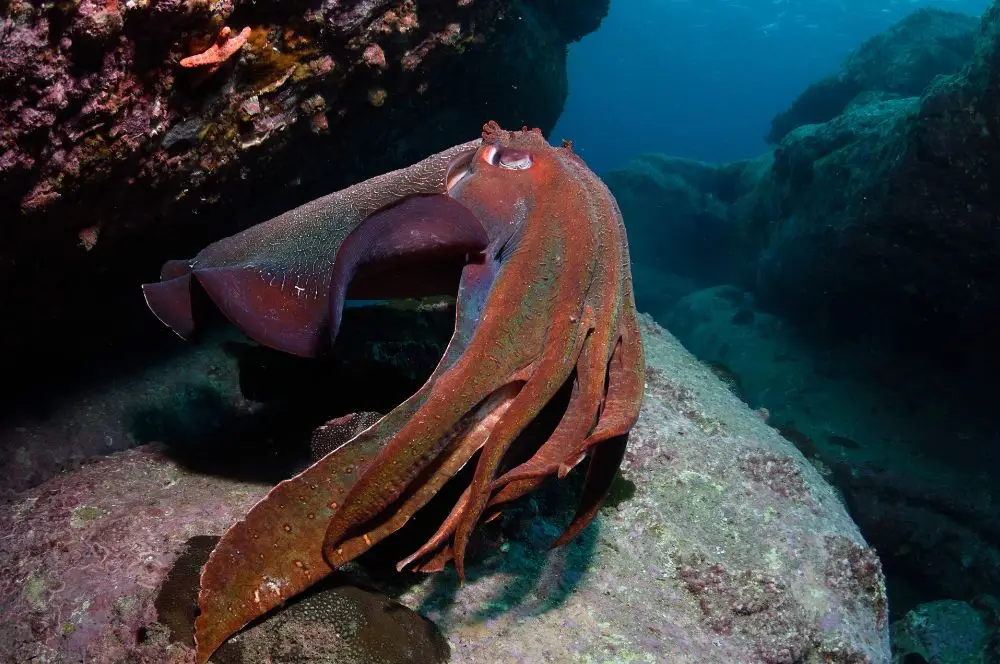
Giant Australian Cuttlefish in Sydney
How to recognise the world's largest cuttlefish, where Sydney divers may encounter one and how to observe it responsibly.
The giant Australian cuttlefish (Ascarosepion apama, formerly Sepia apama) is the world's largest cuttlefish. Sydney divers may encounter these remarkable cephalopods around rocky reefs, caves, ledges and kelp habitat, where they can alter their colour, pattern, skin texture and posture within seconds. They are wild animals and sightings are never guaranteed, so the best encounters come from remaining calm and allowing the cuttlefish to control the distance.
Giant Australian cuttlefish at a glance
What makes it a cephalopod?
A cuttlefish is a marine mollusc related to squid and octopuses. It has eight arms around the mouth and two longer retractile feeding tentacles used to seize prey. Its soft body contains an internal calcium-carbonate structure called a cuttlebone, which helps regulate buoyancy and is often found washed onto beaches.
Giant Australian cuttlefish are endemic to Australia. The Australian Museum records the species from New South Wales around southern Australia to Ningaloo in Western Australia, including Victoria, South Australia and parts of Tasmania.
How large can it grow?
Large animals can approach one metre in total length, including the arms and feeding tentacles. The mantle can reach about 50 centimetres, and exceptionally large individuals can weigh up to approximately 10.5 kilograms. Those dimensions make Ascarosepion apama the world's largest cuttlefish species.
The current name reflects a recent taxonomic update. Older dive guides and many scientific publications use Sepia apama; that familiar name remains a recognised synonym for the same animal.

How giant cuttlefish change colour and texture
Expandable pigment organs called chromatophores allow a cuttlefish to produce spots, bars, waves and high-contrast patterns almost instantly. Reflective cells beneath them contribute pale and iridescent effects. Muscular structures in the skin can also raise papillae, changing a smooth body into a rough outline resembling rock, sand or seaweed.
These changes have several functions. A cuttlefish may camouflage itself against the reef, signal during courtship, confront a rival or alter its appearance while hunting. It is more accurate to describe the visible pattern and context than to assign human emotions such as friendliness or curiosity.
Where Sydney divers may see giant cuttlefish
Sydney encounters usually involve a solitary animal or a small number rather than a predictable gathering. Look carefully around broken rocky reef, kelp edges, overhangs and the boundary between reef and sand. A cuttlefish may remain almost invisible until it moves or changes pattern.
Abyss divers report occasional sightings around southern Sydney sites such as Oak Park and the Kurnell coast near Cape Solander. Cape Solander is exposed and suited to experienced divers in appropriate conditions. Suitable habitat does not guarantee an animal will be present, and the safest site choice must always be based on conditions, access and the divers' experience—not a hoped-for sighting.
Is there a Sydney cuttlefish season? Mature animals and courtship displays are often reported during the cooler months, but Sydney does not have a fixed, dependable mass-aggregation season. Recent observations and suitable dive conditions are more useful than choosing a dive solely by month.
What divers may observe
A settled cuttlefish may hover just above the seabed using the fins along its mantle, walk on its arms, shelter beneath a ledge or move slowly across reef and sand. When hunting, it can extend its two feeding tentacles with exceptional speed. If disturbed, it may darken, flare its arms, ink or jet away. These responses are reasons to pause and give it more space—not invitations to follow.
The species lives for approximately one to two years. Females attach eggs beneath rocks and in crevices, and most adults die after spawning. Never turn rocks or reach into a crevice looking for an animal or its eggs.
How to observe a cuttlefish responsibly
Settle before approaching
Establish neutral buoyancy, slow your breathing and approach from the side rather than descending directly onto the animal.
Let the animal choose the distance
Never touch, chase, feed, surround or block a cuttlefish. Stop advancing if it moves away or changes behaviour.
Protect the reef around it
Keep fins, gauges and camera equipment clear of rock, kelp and crevices. Avoid stirring sediment or resting on the seabed.
Leave a clear retreat route
Allow open access to shelter and move on if other divers are beginning to crowd the encounter.
Sydney sightings and the Whyalla aggregation are different experiences
The animals seen around Sydney are the same species involved in the famous breeding aggregation in South Australia's Upper Spencer Gulf. Sydney sightings are generally opportunistic encounters during a broader reef dive, while Spencer Gulf attracts large seasonal numbers for breeding. Because conservation and access requirements can change, check our dated guide before planning a South Australian visit.
Read the current diving and access guideFrequently asked questions
Is a giant Australian cuttlefish actually a fish?
No. It is a marine mollusc and a member of the cephalopod group, alongside octopuses and squid.
What is the scientific name of the giant Australian cuttlefish?
The accepted name is Ascarosepion apama. Many older dive guides and scientific publications use Sepia apama, which remains a recognised synonym.
How large can a giant Australian cuttlefish grow?
Large individuals can approach one metre in total length and weigh up to approximately 10.5 kilograms. The mantle itself can reach about 50 centimetres.
Where can divers see giant cuttlefish around Sydney?
They may be encountered around rocky coastal reefs, caves, ledges and kelp habitat. Abyss divers occasionally see them at sites such as Oak Park and suitable Kurnell reefs, but no location can guarantee a sighting.
What is the best time to see giant cuttlefish in Sydney?
Sydney encounters are opportunistic and should not be treated as having a guaranteed season. Mature animals and courtship displays are often reported during cooler months, but recent observations, suitable conditions and safe site access are more useful than choosing a dive solely by month.
Are giant cuttlefish dangerous to divers?
They are not generally regarded as a threat to divers, but they remain wild animals. Divers should avoid touching, chasing, cornering, feeding or otherwise interfering with them.
Authoritative species references
Explore Sydney's temperate marine life
Choose a guided dive that suits your experience, enjoy the whole reef and treat every wildlife sighting as a welcome possibility rather than a promise.

 Trusted by Sydney divers